Disability and Faith – Part 2

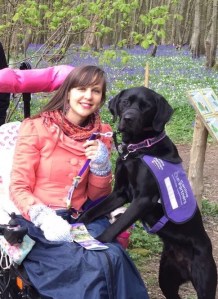
A picture of a woman in a wheelchair (Sally) with her assistance dog, Ethan.

Sally Whitney, Co-Researcher, Living Life to the Fullest

Living Life to the Fullest Co-Researcher Sally Whitney has had an article published in Roofbreaker, an online magazine from Christian disability charity, Through the Roof. The article, in which Sally makes sense of her disability and illness experiences through her faith, has been published over three editions. Last month we published part one, below we share part two.

I was lost. Who was I if I wasn’t going to be a doctor? More than that, my preceding journey of ill health had taken so many twists and turns along the way that I almost didn’t notice that I had lost so much. And then… then it came to the surface. I had lost my identity. I didn’t recognise myself. I had lost friends along the way, I had lost my childhood boyfriend, I had lost a relationship with a close family member who couldn’t handle the intensity of my illness. I had lost my studies, my career, my way of serving the Lord. I had lost my physicality, I couldn’t carry out recreation or walk easily. I gained so much weight through medical treatment that I no longer recognised myself in the mirror. I didn’t even have the same wardrobe of Sally. Who was I? I later recognised that I was grieving for the Sally of my youth, her hopes and dreams- all of those had died. I couldn’t take it any longer and I broke down in a service at church. I was half crying because of the pain racking my body but then I was sobbing for another reason. I was so battered and bruised, so completely stripped of everything I knew, that I thought coming back from this point was impossible. I couldn’t humanly see how I could proceed. I had been pruned back so far that I was barely recognisable as a living thing. Jesus tells us of one of the secrets to Christian fruitfulness is pruning (John 15 vv.1–2). The purpose of pruning is so that you can bear even more fruit. Pain, sorrow, sickness and suffering, loss, bereavement, failure, disappointment and frustrated ambition are some of the ways your life is pruned. But pruning

makes way for new life.

I surrendered. Totally and completely. I lay down at the foot of the cross and gave the only thing I had left, my soul. Jesus was the only one who could take my shame, my loss, my pain, and pin it to the cross. He loved me and only He could take my brokenness and make it whole. I had been describing myself to my friends as a broken statue that had shattered into a million pieces. I could potentially be put back together but I would never be beautiful and flawless again. I was tainted. But that’s why I needed Jesus. It would be years late, here at St Peter’s, when I heard of the Japanese art form of ‘Kintsugi’- fixing broken pottery with gold paste-making the whole all the more unique and priceless. At the point of falling at Jesus’ feet, I didn’t feel beautiful, but I knew I needed him. I had the realisation that I wasn’t enough in my own right and only Jesus could take my weaknesses and make me strong.

I held fast to the verse in 2 Corinthians 12:9-11, “My grace is sufficient for you, for my power is made perfect in weakness. Therefore I will boast all the more gladly about my weaknesses, so that Christ’s power may rest on me. That is why, for Christ’s sake, I delight in weaknesses, in insults, in hardships, in persecutions, in difficulties. For when I am weak, then I am strong.” I placed a card with this verse on at the foot of my bed so every day I could try and convince myself that my weaknesses may one day be strength.

So there I was, broken and ill, getting new unexplainable symptoms every day but knowing that I needed new plans fixed in Jesus. Having given up on the medicine dream, I transferred to study cognitive science and started at Sussex university in 2011. I was determined that I could make this work and I would do it for the glory of God.

I put all my trust in God to make it work this time. It wasn’t easy, I was getting progressively weaker and many physical problems in all my major body systems would come up and weaken me further. My weekly trips to see specialists in London were exhausting and left me no time to study. More than that, my physical health meant socialising was becoming increasingly difficult. When I was able to attend church I felt surrounded by God’s love and felt him present in my life more than ever before.

I was diagnosed with Ehlers-Danlos syndrome and associated conditions in the Spring term of my first year and that meant a battery of new tests and treatments. I became unable to participate in anything and realised that God’s love and goodness was so much easier to access in community. I was faced with the problem of how I could be in community when my body was physically too weak to join in. I also came face to face with the realisation that my illnesses weren’t going away. This was for life. Although I was a unique child of the Father, I would always be broken and flawed. The realisation only came later that this is the case for everyone, regardless of whether their bodies worked or not.

After I successfully made it into the 2nd year I fell broken at the foot of the cross again. After losing all blood flow to my hands, turning them black, I had my most severe and life-changing seizure. In the frenzy of the resuscitation area of A&E, after hours of seizing, I stopped breathing and I had to be resuscitated. I was intubated, put on a ventilator and into an induced coma. I had had a respiratory arrest and a whole new battle lay in wait.

I was in intensive care for a very long time, having seizure after seizure, before I was moved to the National neurology hospital in London. The seizures were unbelievably painful as I would dislocate my joints as I writhed, contort into unbelievable yoga like positions with the soles of my feet meeting my head, and I was in a constant state of confusion due to the drugs. But this time, despite the seriousness of my situation, I coped better. I had Jesus. I had surrendered. Whatever happened, my hope was pinned on Him. I was put into an isolation room on the ward as I had contracted an infectious virus and so I had very little contact with anyone else. I was alone again. But when I was able, I would put on worship music on my phone and lie in the presence of God’s love. I must have listened to the Oceans album by Hillsong at least every day of my stay. And I experienced joy, yes, joy from revelling in his presence. I still had not lost hope. Psalm 67 verse 7-8 says; Because you are my help, I sing in the shadow of your wings. I cling to you; your right hand upholds me. And that’s what I did, I clung on. I clung on to him and I clung onto life. That’s what I continued to do after I was discharged. Once again, I had to learnt to sit up. Once again, I had to learn how to eat a meal without seizing. 5 years later I haven’t cracked learning to walk. My life had changed dramatically again. I was largely confined to a bed and then a wheelchair and I continued to have violent seizures. I also continued to have respiratory arrests. I have been in intensive care just under 10 times, yet each time I have pulled through and started breathing again after coming out of the coma. And I breathe in more than oxygen. I breathe in His life-giving spirit. My new situation of having carers with me 24/7 and risking respiratory arrest at any point was made easier by taking solace in the Bible. I took reading it as seriously as I did my physio exercises. I still do. He is where my help comes from.

And still questions plagued my mind: Could I return to society? Would life ever again contain the normal things that I desired? Would I ever be able to stop fighting this battle for life?

Imagining different futures with disabled young people

Imagine no one ever asking what your hopes, dreams, ambitions and fears are? Imagine being a twenty-four year old young woman and no one has asked you how you feel? Perhaps you can’t imagine.

But disabled young people with life-limiting and life-threatening impairments tell us that this is their lived experience. A focus on medical interventions and social care means that the young person’s feelings are lost. It is important, of course, to focus on the practicalities of young people’s lives, but sometimes this means that many of the aspects of what it means to live well are ignored.

Disabled young people tell us that they face the challenges of living with impairments but that their lives are limited by other people’s failure to see the person. They want people around them to understand that they have hopes, dreams and ambitions and that they can and do live full lives.

On 6th November, as part of the Economic and Social Science Festival in Sheffield, The School of Education and iHuman Sheffield hosted an event at which Sally Whitney and Emma Vogelmann spoke about their experiences disabled young researchers. They are part of a co-researcher collective at the University of Sheffield which is exploring the lives of young people with life-limiting and life-threatening impairments as part of an Economic and Social Research Council funded project Living Life to the Fullest: life, death, disability and the Human. Working with Katy Evans, Lucy Watts MBE, Carrie Aimes, and Ruth Spurr, Emma and Sally have been involved in research design, interviews and analysis and are co-authors of a peer-reviewed article for the academic journal Children & Society, alongside the university researchers Dr Kirsty Liddiard, Professor Dan Goodley and Professor Katherine Runswick-Cole.

The researchers made a short film screened at the event that describes what being involved in research means to them. You can watch the film here.

Sally and Katherine appeared on BBC Radio Sheffield after the event to talk about the discussion we had. You can listen here.

We would like to thank the co-researchers and everyone who came to the event and made such wonderful contributions to the discussion.

Busy room at the event

For more information about the project, contact: k.liddiard@sheffield.ac.uk


What does it mean to live life to the fullest?

What does it mean to live life to the fullest? poster

Excitingly, our funders the Economic and Social Science research Council (ESRC), have issued a press release about our project, Living Life to the Fullest. The press release, which we share below, is to promote our ESRC Festival of Social Sciences Event, The Co-Researcher Collective: What does it mean to live life to the fullest? #LiveFull2018, happening today (Tuesday 6th November 2018) in Sheffield. At the event, we will screen our co-produced short film, and co-researchers Sally Whitney and Emma Vogelmann will speak about their experiences of being and becoming researchers on the project. Please check out our hashtag #LiveFull2018 on Twitter to follow the event online.

Imagining different futures with disabled young people

The ambitions and future goals of disabled young people with life-limiting and life-threatening impairments are being documented for the first time in an innovative study.

Initial findings suggest that this group of disabled young people feel frustration that society treats them as ‘tragedy cases’ because they could die young. This discrimination can be a barrier to enjoying full lives as other teenagers and young people do, according to the research. Attending parties, achieving work and career aspirations and even indulging in rebellious behaviour are among the experiences often denied to them.

The ESRC-funded Living Life to the Fullest project led by a team of academics, Kirsty Liddiard , Dan Goodley, and Katherine Runswick-Cole at the University of Sheffield will be the focus of an event as part of the annual Economic and Social Research Council’s (ESRC) Festival of Social Science.

Professor Jennifer Rubin, ESRC Executive Chair, said: “The Festival of Social Science is one of the largest co-ordinated endeavours undertaken by a science community and demonstrates ESRC’s commitment to public engagement. We know social scientists and economists value the opportunity to talk with the public to make an impact with their work. These events should inspire young people to pursue a career in social sciences and raise awareness about the impact made to wider society.”

Dr Liddiard, from the School of Education at the University of Sheffield says: “Young disabled people with life-limiting and life-threatening impairments want to plan their futures and have the space to be normal,

“But our initial research suggests they feel their futures are often shut down because they’re seen as having ‘short lives’. People respond emotionally so they’re often stuck with labels like ‘brave’ or ‘inspiring.’

“This can make developing a sense of identify and self-hood difficult. It’s therefore vital that the views of these young people and those of their families are heard.”

Life-limiting or life-threatening impairments are those with no reasonable hope of cure and can result in early death. Until now, this group has been excluded from disability research.

Dr Liddiard and her colleagues have set out to listen to people’s stories to increase understanding about their experiences. They have recruited six people aged from 18 to 30 called the Co-Researcher Collective to co-lead the project, including carrying out data collection through peer-to-peer interviews.

These have been conducted via Skype, FaceTime and Facebook Messenger which is a departure from the traditional method of travelling to meet interviewees. “This group of disabled young people is often seen as hard to reach and that engaging with them takes time and resources,” says Dr Liddiard.

“The co-researchers’ advice on asking these marginalised young people sensitive and ethical questions has been invaluable. We’re not solely focusing on issues such as end-of-life, being at-risk or illness. The aim is to explore what disabled young people with shorter lives want to achieve.”

A website set up by the research team includes blogs from young people such as on the joys of fulfilling ‘bucket list’ dreams. Lead co-researcher and health and disability activist Lucy Watts MBE writes about her experience camping at a festival and feeling ‘so free’ when treated the same as others at the event.

The next step is to carry out in-depth interviews with around 20 parents. Getting their views is important, Dr Liddiard points out, because disabled young people with such conditions often spend more time within families because they often do not go off to university.

This is predominantly because of the considerable barriers they face within education. Dr Liddiard says: “It’s extremely difficult for a parent knowing they might outlive their child. But these parents are fighting for their children’s futures.”

Living Life to the Fullest is also developing arts projects such as a poetry workshop to capture people’s experiences. This is in collaboration with organisations including Purple Patch Arts and the Attenborough Arts Centre.

Says Dr Liddiard: “The notion of a dying child is inherently emotive in our culture. But we should be focusing not on pity but on the injustice young people face and how to live life to the fullest.”  

Dr Liddiard and the Co-Researcher Collective will be sharing their findings as part of an event entitled The Co-Researcher Collective: Living Life to the Fullest on 6th November for the general public, academics, practitioners, disability activists and organisations, and students. The event is part of the ESRC’s flagship annual Festival of Social Science.

For further information contact:

Kirsty Liddiard

Email: k.liddiard@sheffield.ac.uk

Telephone: 0114 2228111

ESRC Press Office:

James Dixon

Email: james.dixon@esrc.ac.uk

Telephone: 01793 413122

Notes for editors

Location: Sheffield. Date: 6 November 2018. Time: 14:00 – 16:00

It’s a poignant truth that those who live shorter lives often live life to the fullest. This is the inspiration behind a new project that explores the lives, hopes, desires and contributions of disabled children and young people with life-limiting or life-threatening impairments.

The project, Living Life to the Fullest lets children tell their own stories using art, for example painting, drama, film making and sketching. You can’t do high-quality research about young disabled people’s lives without including young disabled people in the process, so this groundbreaking study is co-led by The Co-Researcher Collective, a group of young disabled people who work alongside academics at Sheffield University, making decisions, collecting data and writing, sharing and promoting the research and its findings.

At this event, the collective will present a screening of their short film Living Life to the Fullest: The Co-Researcher Collective (2018). After this they will lead a discussion about the project’s core themes of life, death and quality of life – deeply pertinent social and cultural issues in today’s society. Audience members will also have the chance to learn more about research co-production from the young people themselves. The venue is fully accessible (contactk.liddiard@sheffield.ac.uk with access requirements). BSL signers will also be present.

  • The 16th annual Festival of Social Science takes place from 3—10 November 2018 with over 300 free events nationwide. Run by the Economic and Social Research Council, the festival provides an opportunity for the public to meet some of the country’s leading social scientists to discover, discuss and debate how research affects their lives. With a range of creative and engaging events going on across the UK, there’s something for everyone including businesses, charities, schools and government agencies. The full programme is available at: www.esrc.ac.uk/festival. Catch up and join in on Twitter using #esrcfestival.

ESRC logo


Published!

Children and Society front coverWe are thrilled to say that an article we have co-written as a research team has been accepted for publication in the leading journal, Children and Society. The article, entitled “I was excited by the idea of a project that focuses on those unasked questions” Co-Producing Disability Research with Disabled Young People, details the politics and practicalities of co-produced disability research with disabled young people with life-limiting and life-threatening impairments.

The article highlights the absences of disabled children and young people from ‘child-led inquiry’ – research that positions children and young people as potential leaders of research and who have ‘an alternative, legitimate expertise to that of academic researchers’ (Nind et al. 2012: 660).

Some proponents of child-led inquiry argue that, inevitably, some aspect of the research process are better managed by adults (see Nind 2008); for example the writing up and publishing of research findings (Bailey et al. 2014; Nind et al. 2007). As Abell et al. (2007) state, it is academics that have the access to computer technologies, experience of academic writing, and knowledge of peer review and publication. However, we are explicit that our article has been co-authored with Living Life to the Fullest young co-researchers, and we purposefully detail these methods of co-authorship (see Walmsley, 2004). Thus, our focus in our article is not to debate whether disabled young people should be included in research, but to show how (see Tuffrey-Wijne, Bernal & Hollins, 2008): what we have learned from our experiences in Living Life to the Fullest so far and how these can helpfully inform other researchers.

We share our abstract below; the article will be out in due course, and will be open access, meaning it can be accessed by all.

Liddiard, K., Runswick-Cole, K, Goodley, D., Whitney, S., Vogelmann, E. and Watts, L. (accepted) ‘”I was excited by the idea of a project that focuses on those unasked questions”: Co-Producing Disability Research with Disabled Young People’, Children and Society.

“I was excited by the idea of a project that focuses on those unasked questions” Co-Producing Disability Research with Disabled Young People

 In this article we detail the politics and practicalities of co-produced disability research with disabled young people with life-limiting and life-threatening impairments. We centre an ESRC-funded arts-informed co-produced research project that has brought together a Co-Researcher Collective of disabled young people. Co-production is an established approach; however, our co-researchers have led us to develop inclusive research practices that engage with online social research methods in innovative ways. As we detail our experiences, we aim to encourage disability studies researchers and others to adopt virtual environments when researching with and for the lives of disabled people.

Keywords: co-production; life-limiting, youth, online, virtual

References

Abell, S. et al. (2007) Including everyone in research: The Burton Street Group, British, Journal of Learning Disabilities, 35, 121-24.

Bailey, S., Boddy, K., Briscoe, S. and Morris, C. (2014) ‘Involving disabled children and young people as partners in research: a systematic review’, Child: care, health and development, 41, 4, 505–514

Nind, M. (2008) ‘Conducting qualitative research with people with learning, communication and other disabilities: Methodological challenges’, ESRC National Centre for Research Methods Review Paper, National Centre for Research Methods

Nind, M., Flewitt, R. & Payler, J. (2007) The experiences of young children with learning disabilities attending both special and inclusive preschools, Report for Rix, Thompson, Rothenberg Foundation, University of Southampton.

Nind, M. Wiles, R., Bengry-Howell, A. and Crow, G. (2012) Methodological innovation and research ethics: forces in tension or forces in harmony? Qualitative Research, 13: 6, 650–667

Tuffrey-Wijne, I., Bernal, J. & Hollins, S. (2008) ‘Doing research on people with learning disabilities, cancer and dying: ethics, possibilities and pitfalls’, British Journal of Learning Disabilities, 36: 3, 185-90.

Walmsley, J. (2004) Inclusive learning disability research: the (nondisabled) researcher’s role, British Journal of Learning Disabilities, 32, 65-71.

Congratulations, Lucy!

It’s been a brilliant couple of weeks for Living Life to the Fullest Lead Co-researcher, Lucy Watts MBE. Not only has she just been awarded with an Honorary Degree of Master of the University from the Open University, but she has had an article on young disabled people and transition published in the British Medical Journal (Watts, 2018).

Photo of Lucy celebrating

Photo courtesy of Lucy Watts: http://www.lucy-watts.co.uk/

On Friday 21st September, Lucy was awarded her Honorary Degree of Master of the University at the Barbican, London. Recognised for years of hard work, Lucy was awarded for her commitment to public services.

She said, ‘I am truly honoured to have received this honorary masters but I accept it not just for myself, but for all the people and organisations who’ve played their part in my life, believed in me, kept me alive, given me quality of life, supported me and enabled me to achieve all that I have achieved and had an impact on me and my life in whatever way. I recognise that whilst it is my hard work, dedication, perseverance and achievements that are being recognised, that behind me is an endless list of people who’ve played a part – some big, some small, some monumental – in my life and thus my success’. To learn more and read Lucy’s acceptance speech, check out her blog here.

In the same month, as well as turning 25, Lucy has published an important article in the British Medical Journal, a weekly peer-reviewed medical journal and one of the world’s oldest general medical journals.

In her BMJ article, Lucy argues that transition should not be a considered a one-time event; she says, ‘Transition is a process, not a single event. When done right it sets the scene for a young person’s care in adult services. When it is done wrong a young patient might not be able to cope and may even disengage from services. Becoming an adult is a process that continues over years. Young adults aren’t big children nor are they little adults; they are a unique subgroup of the population and need to be treated as such’. To read Lucy’s article, please see here.

All of us here at Living Life to the Fullest are really proud of Lucy’s achievements.

References

Watts, L. (2018) Stepping up to adult services, British Medical Journal362, doi: https://doi.org/10.1136/bmj.k3886

Rethinking Disability and Faith

Through the roof logoLiving Life to the Fullest Co-Researcher Sally Whitney has had an article published in Roofbreaker, an online magazine from Christian disability charity, Through the Roof. The article, in which Sally makes sense of her disability and illness experiences through her faith, will be published over three editions.
Editors Ros Bayes said, “We received this moving testimony from Sally, one of our Roofbreakers. After reading it, I was so moved that I decided, rather than write a thought for the month, I would allow her testimony to speak to us all and challenge us about the depth of our relationship with God.”

We are grateful to re-post Sally’s article below – you can also access it here, in Roofbreaker.

“My Parents Were Told to Say Goodbye to me as it was the Last Time They Would See me Alive…my Only Refuge was the Presence of God.”

My childhood was idyllic. I grew up in a very loving family, went to excellent schools and never wanted for anything. I knew what it was to feel loved and I knew what it was to work hard but I had no idea what it was to suffer. I grew up believing in and loving God. I went to Mass most Sundays and catechism on a Saturday. I knew Bible stories, I was sorry when I did something wrong and I prayed to God every night. I didn’t however have the intimacy of relationship that kindles trust. I didn’t know what it was to trust God fully in all things, I had no reason to put all my faith in him. I had not surrendered and I thought that I had to earn His love.

I studied 4 A-levels and decided to study medicine as I wanted to make a meaningful difference to the world and to serve God. I received a place at several medical schools and was planning to embark on my journey into medicine in September 2005.

However, in the Spring of 2005 I came down with a virus. Initially I thought I had really bad flu. I was in a lot of pain and couldn’t get out of bed. I was extremely tired and developed a goitre – a large lump in my throat which turned out to be my inflamed thyroid. It later was diagnosed that I was suffering from thyroiditis.

I had always achieved my goals by pushing hard and working at things until I got to the place I wanted to be. I adopted the same methodology to overcoming my illness. I refused to stay in bed but went to join my family on a skiing holiday that they had already flown to the Alps for. I arrived at the chalet feeling exhausted, beyond any tiredness that I had felt before and in a lot of pain. I had to go straight to bed. I could only ski for a very short period of time before coming home and going back to bed. Finally I had to admit defeat that the skiing holiday was not meant to be. I returned to the UK and focused my energies towards taking and passing my A-levels that would take place in the summer.

I was still constantly tired, plagued by pain and unsure what was happening to my body. I would drag myself into school only to be sent home or to be told to go and lie down in the common room as I was visibly flagging in lessons. I started spending more and more time in bed and was not able to revise for my examinations I pushed myself hard to go into each A-level exam. However special arrangements had to be made after I collapsed in one of the exams. In another one I passed out and had to crawl out of the room before being rescued – found stranded on the stairs. It was eventually deemed unsafe for me to continue and I missed my final few examinations.

Despite everything, I received my A-level results in the August and got four A’s. I arrived at school to collect my results in a wheelchair. It was explained to me that I was now suffering from post-viral fatigue. I had to decide how I was going to get to Edinburgh to study medicine in September. It became increasingly clear that with only a few months left I wasn’t going to be fit enough. Despite my strong beliefs in God and despite my real fear and awe of him, I don’t remember praying to him to take away my illness or to help me get medical school on time. I think I still thought that I could push through and do things on my own, through hard work, as I’d always done.

I was diagnosed with M.E./chronic fatigue syndrome. That Autumn I started to have seizures, violent spasms that would cause my whole body to contort, sometimes for hours at a time. Nobody knew what was going on, not the doctors, not my parents and not me. The seizures became more frequent, set off by increasingly minor triggers; sitting up for too long, eating a large meal, a change in temperature.

This changed things. Suddenly, things seemed more out of my control and I was less and less in command of my own mind. I was wracked by guilt. The guilt that I was worrying my parents so much, that I was burdening them with endless care needs. I was disturbing my younger brother’s life as he carefully carried me to bed after starting seizures at meal times and lay with me while I writhed. I was letting everyone down; I wasn’t at university, I wasn’t training to be a doctor and I wasn’t following the star-studded path that I had set out. My guilt and severity of illness led me to cling to God. I would beg Daddy to take me to Mass where I would sit slumped, trying to hold my head up. If I made it through the service without seizing, I would then beg to go to confession. I would profusely apologise to God over and over about letting Him down, not being strong enough for Him, not being the girl I thought He expected me to be, and mostly for being a burden; for causing so much pain to my family that I was taking up all their time and energy – causing them to suffer immensely. The priest wouldn’t accept my confession. He pointed out that I wasn’t sinning, I was ill and it wasn’t my fault. I didn’t believe him.

I was in hospital in Essex for almost 8 months, where I was neglected, abused and punished for not responding to treatment and not being a typical ME patient. I would later find out that this was because I did not have ME but several other rare conditions. I was totally alone. Initially I was allowed no visitors, and then weeks after, I was only allowed short, timed visits from family at weekends – just like in prison. The hospital didn’t feed me and my weight plummeted (eventually, after much pleading, I was fitted with a feeding tube), my seizures ratcheted up a notch and I became more and more incapacitated. Soon, I was totally bed bound, paralysed by weakness to the extent I could only move my right hand. I couldn’t speak. I was like an infant in my physical needs, but also an infant in my spiritual relationship with God. I needed Him like a baby needs its parent – I didn’t have a clear understanding of this relationship but the need and helplessness was there.

My parents were told on multiple occasions to say goodbye to me as it was the last time they would see me alive. Amidst the constant bombardment of punishment and pain, my only refuge was the presence of God that I found in the visits from hospital ministers and lay people.
The Bible is God’s life support to us as we encounter a world of difficulty. It literally was that – life support. My meetings with God in this world of pain kept me going, sustained me. I still couldn’t physically eat and was severely malnourished. My flesh and my heart may fail, but God is the strength of my heart and my portion forever. (Psalm 73). God gave me the strength to keep on living – I lived off Him. Slowly, I regained my strength, learned to sit up, and my seizures slowly decreased in frequency.

I have no doubt in my mind that without God, I wouldn’t have survived. BUT I knew joy. He planted hope in my soul, wonder in my mind and joy in my heart. I felt immense joy at the feeling of the breeze on my skin or a bumble bee buzzing near my head. I saw God’s beautiful creation in a whole new light. It was as if I had died and entered a whole new world. I wanted to do everything. Talk to everyone. Really LIVE! Such dark times led to me seeing everything in wonderful, vibrant HD! Each new experience, for example the simple task of ordering a coffee, had to be relearned as if it were brand new! I had been set free from the prison of hospital and entered a world of lightness.

Soon after being discharged, I was correctly diagnosed with some of the conditions I suffer from, the main one being an autoimmune condition called Lupus. It is a disease where your immune system acts over-zealously and attacks the body’s own tissues. Although there is no cure, there is medication that can help symptoms and the simple feeling of being understood and cared for was a treatment in itself. In truth, I thought I had been healed. I really believed that God had given me a second chance to pursue my dream. I was so grateful to this God, this Father that had saved me that I wanted to find out everything I could about who He was. Things that were once central in my life were mundane – all I wanted to do was talk about and worship this God who had saved me.

By now, I had lost my place at Edinburgh medical school and had to reapply all over again. I threw myself into preparation for examinations and interviews with the same ferocity that I had pre-illness. I was accepted into 3 medical schools, despite still being unwell. It seemed miraculous that my brain still functioned well enough to study medicine, that I had persuaded the medical schools to give a sick girl a chance. I chose Brighton to be the place where I would try again.

Psalm 37 v.4 says, Take delight in the Lord, and he will give you the desires of your heart’. Rather than pursuing the things you desire, if you delight in God he will give you the desires of your heart. I thought that was what I was doing, ALL my joy did come from the Lord, but somehow I was wrong.

I started medical school in 2009 and loved it. I did well on the wards and in the work. Yet my illness still taunted me. There was misunderstanding over the cause of my symptoms. Once again there was lack of belief over the validity of my illnesses and whether I even had the correct diagnosis. Soon I found myself fighting again.

Another miracle, my prayers were answered; I could continue at Medical school, my stubborn desire to follow my own plans was rekindled. But it wasn’t to be. Soon, my health deteriorated and I was back in hospital. All of the fighting to be believed, the wrestling with God for answers, was in vain.

I was treated more aggressively for my lupus but my symptoms continued inexplicably. I was told by my lupus doctor that I would never be a doctor, I would never finish my medicine course.

This was the most crashing blow to me. It far outweighed the frequent dances with death I had experienced in Romford and the terrifying medical emergencies to come.

Sally Whitney, Living Life to the Fullest Co-Researcher

To be continued next month.

The Living Room – “It’s a masterpiece!”

The Rightful Lives Exhibition HomepageHere at Living Life to the Fullest, we are thrilled to say that the artwork of two young disabled artists who participated in our first Arts Retreat in 2017 – facilitated by our brilliant community research partners, Purple Patch Arts – have had their work included in a new exhibition, Rightful Lives. Fraser Carr, Living Life to the Fullest Artist said, “It’s a masterpiece!”
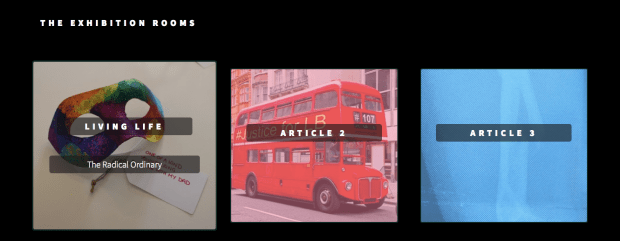
Check out the online exhibition, here! The Living Life to the Fullest project has been located in The Living Room section of the gallery – take a look here!

Images from the The Living Room gallery

Fraser Carr and Brandon Styles agreed to be part of Rightful Lives – an online exhibition highlighting the lack of access to human rights experienced by many disabled people (particularly those with autism and/or learning disability), as well as the grave violence experienced by many disabled people and their families through the systemic problems and failures in health and social care. For example, see the Mazars Report (2015) and the recent Learning Disabilities Mortality Review (LeDer) (2015-2018). See here to learn more about the background to Rightful Lives.

Rightful Lives begins on Monday 24th September 2018 and will run for a week. You can follow the progress of the exhibition on Twitter at @RightfulLives or the hashtag #RightfulLives or on Facebook at #RightfulLives. 


Exploring ‘in-between’ spaces: drawing on arts-informed methods in critical disability studies

This week’s blog post has been written by Living Life to the Fullest’s Professor Katherine Runswick-Cole.

Living Life to the Fullest, funded by the Economic and Social Research Council, focuses on the lives of disabled young people who have what are termed ‘life limiting or life threatening’ impairments.  They are a group of young people who have traditionally been ignored or marginalised in research and who have had little chance to take control of what is said about their lives.  The university project team includes: Dr Kirsty Liddiard, Professor Dan Goodley and Professor Katherine Runswick-Cole (The School of Education).
The research is being carried out with disabled young people who are leading and driving the project forward.  The Co-Researcher Collective has been actively involved in carrying out the research with lead Co-Researcher Lucy Watts, MBE, guiding the team.
Professor Katherine Runswick-Cole, iHuman and The School of Education, was delighted to present work from the project as part of a research trip to Australia which also included a keynote at Queensland University of Technology (QUT) focused on inclusive education.
In her presentation delivered at the University of New South Wales and at QUT, Exploring ‘in-between’ spaces: drawing on arts-informed methods in critical disability studies‘, Katherine spoke about the opportunities and challenges of working through the arts in collaboration with young people to talk about what it means to live life to the fullest.
She was also able to give the audience a sneak preview of the forthcoming Living Life to the Fullest film, made by the Co-Research Collective that will be shown at the Economic and Social Festival of Social Science in Sheffield in November – details here.
Katherine said: “It was a pleasure to be able to share the work we are doing in Sheffield with our young co-researchers.  Colleagues in Australia were challenged and moved by what our Co-Researchers are demanding, of them as researchers and of society as a whole, to ensure that all young people can live life to the fullest.”
Living Life to the Fullest postcard

Being Lucy: Festival Fun @ WOMAD

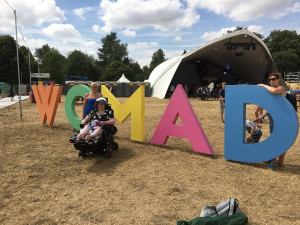
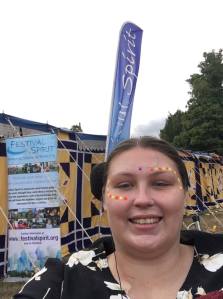
Lucy in front of WOMAD sign

Photograph by Lucy Watts MBE

This week’s Living Life to the Fullest blog post comes from our wonderful Lead Co-Researcher, Lucy Watts MBE:

I’m a 24 year old disabled female with a life-limiting illness. Born with health problems and receiving various interventions whilst growing up, my condition progressed throughout my childhood until I became seriously ill and completely disabled at 14. At 17, after a long time spent avoiding the conversation, my consultant told us that my condition would shorten my lifespan; he didn’t know by how much, but I was certainly not going to live a long life, let alone make “old bones”. I started receiving palliative care alongside life-sustaining interventions and came under a young adult hospice-at-home service. Then a year later, I was told my prognosis was less than 5 years. To reach the age of 24, I’ve already exceeded my prognosis. In October I turn 25; and can say I have survived at least 2 years longer than expected. My life is extremely medicalised, I have 24 hour care of which 16 hours is with an intensive care nurse, I’m dependent on the nutritional equivalent of life support (TPN), being hooked up to intravenous drips at least 21 hours a day through a Hickman Line directly into my heart and requiring intravenous fluids and medications, as well as a tube that drains my stomach continuously and an Ileostomy and also a Urostomy (Ileal Conduit). I’m dependent on a wheelchair, require hoisting to transfer and can do very little for myself. My life can feel like one long medical procedure. My illness meant that as my peers became more independent and their lives were progressing and their world opening up, and they were discovering their identity, experimenting and planning for their adult life, I was becoming increasingly dependent at a rapid rate, my life was regressing and my world getting smaller and smaller, I had lost my identity, stuck in bed at home, unable to socialise much at all and missing out on the transition into young adulthood. Now, over a decade on since my body finally gave up, I’ve missed out on much of my young adulthood. I don’t get to be a young adult much at all. I live an incredible life, with my voluntary work going from strength to strength and so many amazing opportunities opening up and achievements made, but I don’t often get the chance to just be a young adult and do ‘young adult’ things.

Then, a while back, Philippa at St Christopher’s Hospice asked if I wanted to come to the WOMAD Festival (World of Music, Arts & Dance) with them, supported by the charity Festival Spirit who provide specialist camping accommodation geared up for people with complex health needs and disabilities. I jumped at the chance. I couldn’t wait for WOMAD to come around, and boy was it amazing; 100 times better than I ever could’ve imagined.

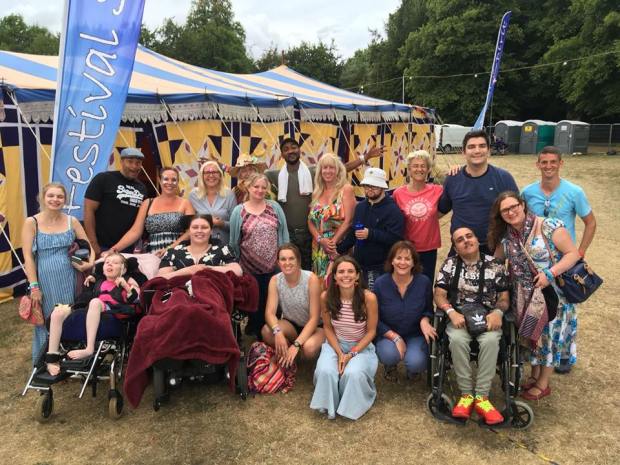
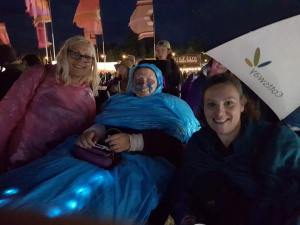
Lucy and friends

Photograph by Lucy Watts MBE

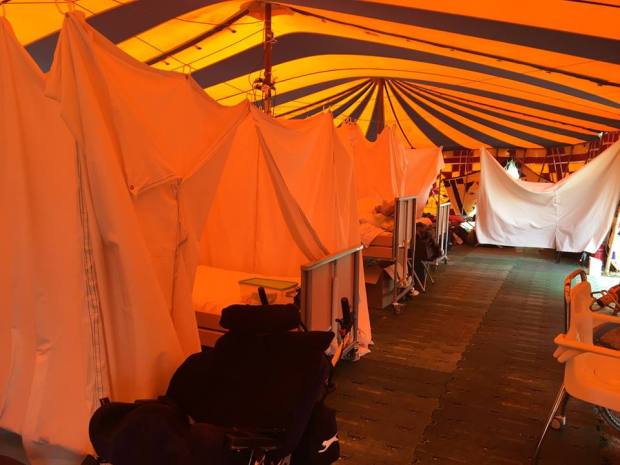
Festival Spirit have a large tent which is split into cubicles (for privacy) with electricity for equipment, a profiling bed, a camp bed for a carer to stay with you as well as having mobile hoists, hard flooring, a separate wheelchair charging tent, a large area full of camp beds for numerous care staff and volunteers to sleep in and even a large heater to try and keep the tent warm. Festival Spirit also purchased a fridge specially for me l store my TPN (intravenous feed). This is the only way I could have ever camped at a festival, without these facilities it would’ve been impossible. We drove to St Christopher’s Hospice in South London and then travelled up to the Charlton Park estate on a coach with everyone. We arrived to be greeted by the Festival Spirit Team and volunteers and wow, the facilities blew our minds. St Christopher’s take young adults to festivals with Festival Spirit every year but this was my first ever experience of a festival. It’d been on my bucket list but it was something that was an “I’ll never fulfil that” item. Until now! On Thursday morning we travelled up to WOMAD and we came home Sunday evening.

WOMAD accessible bedroom

Photograph by Lucy Watts MBE

WOMAD was amazing. The atmosphere was incredible, the music, arts, dance, activities and attractions were fantastic, we had such a great time. I didn’t want it to end. We saw/listened to some amazing acts, my favourites being Ezra Collective, Goldie and Amadou & Mariam. The latter, Amadou & Mariam, are two visually impaired musicians who are husband and wife and were amazing. Despite the fact they sang in French, and I couldn’t understand the lyrics, the music, the performance, the atmosphere, the beat and the impact was mind blowing. I also watched a talk by a hero of mine – who created Touretteshero – and that is Jess Thom, a comedian, performer, writer, producer and disability rights advocate who uses a wheelchair and has Tourette’s. Her talk was interesting and informative, thought-provoking and entertaining in equal measure. Jess really got the audience to think about how – and why – we think of disability as inherently negative when actually it is a part of the natural diversity of the human form and experience and that it can be used as a tool for creativity and a platform to do incredible things. Jess uses her tics as a creative tool which she shares with others to do the same. She created Touretteshero to reframe the narrative and wrote, produced and started in Backstage at Biscuit Land, wrote a book of the same name and has a documentary about performing Beckett’s play Not I. Then I got to meet her – and she recognised me from online as we have mutual friends – most prominently Kirsty (Liddiard) – and often move in similar online circles. So I got to talk to her and we had a great chat and then she signed a copy of her book for me and we said we’d keep in touch. I was a little bit star struck, because I’ve followed Jess online for a long time. That was one of my top highlights, meeting her. Also at WOMAD, the Festival Spirit Team and volunteers, St Christopher’s Team and volunteers and our own carers (including my mum) made WOMAD even better, such great company and I’ve not laughed so much in a long time. Without a doubt, they were some of the best days of my entire life, memories to treasure and experiences I’ll never forget – and forever be shaped by.

Lucy at night at WOMAD

Photograph by Lucy Watts MBE

The thing is, at WOMAD, I could just be Lucy. For once in my life, my ability to do something was not negatively impacted by my illness and disability. I was just the same as any festival-goer. I was a young adult for the first time in years. I can’t tell you how liberating that was. As Festival Spirit had the accessible accommodation and we had the support of St Christopher’s and Mum with me to do all my care, my medical and physical needs faded into the background, paling into insignificance. This was despite the fact I was on intravenous Antibiotics for the sepsis and kidney infection I developed the weekend before WOMAD, on top of all my usual needs. My illness was barely noticeable. We did what we needed to do but our focus was 100% on the festival and the attractions and activities. And not only that, for once I was not in any way defined by my disability, by me or by others. I was not a ‘disabled’ young adult or a ‘disabled’ festival-goer or a ‘disabled’ group member, I was simply me, Lucy, just another person attending and enjoying the festival. I felt so free. I felt like part of something bigger. I felt accepted, welcomed, embraced, valued and appreciated. It really was a pivotal experience in how I perceive myself. With the progression of my condition at 14 I lost who I was; my identity, my hobbies, my hopes and dreams, the goals I had set and the future I had planned for myself. For 5 years, I was completely lost. Then over the last 5 years, I’ve been slowly reclaiming my identity, but this identity even better than the one I had before; one that I’ve found through the extraordinary life I’ve built for myself. This weekend showed me that whilst I embrace my disability and that’ll always be part of my identity – it’s part of me and I refuse to deny it or disassociate from that – that it’s okay to view myself as a person and not just as a disabled person. I am a proud disabled person, that won’t change, but I’ve discovered I’m a person both including and excluding that and that seeing myself as a person first is important. I preach the social model of disability and that disabled people are people first and foremost, and yet I couldn’t see myself as a person first. So WOMAD led to somewhat of a personal epiphany in how I view and perceive myself. Like a puzzle, over the last 5 years I’ve been slowly finding and fitting together the pieces of the puzzle of who I am and why I am here. I feel after WOMAD and my life in recent years, that although not complete, I can fully appreciate the various puzzle pieces, what they mean and why they’re important.

Photo of Lucy

Photograph by Lucy Watts MBE

I do hope to go again next year, although whether it’ll be WOMAD or another festival will be decided nearer the time by St Christopher’s. I’m a festival convert, without a doubt. I didn’t want WOMAD to end, but at the same time I was so tired and ready for home, my own bed and reuniting with Molly, my Assistance Dog. I knew WOMAD would be good, but I couldn’t have foreseen the enormous impact it’d have on me. A transformative experience, as well as an enjoyable one.

By Lucy Watts MBE

Website: www.lucy-watts.co.uk

Twitter: @LucyAlexandria

Listening to Parents’ Stories

Over the last few weeks, Living Life to the Fullest co-researchers have been working on writing an interview schedule for use with the parents and carers of disabled children and young people with the label of life-threatening and life-limiting impairment (hereby LL/LTIs).

Co-researchers have recently finished data collection with young disabled people living with LL/LTIs. Living Life to the Fullest collected young people’s narratives through a unique peer-to-peer interviewing model, as co-researchers in the Co-Researcher Collective led data collection with fellow young disabled people. In our next phase of the project, co-researchers will undertake a series of qualitative semi-structured interviews with parents and carers, seeking stories of their lived experiences of the intersections of parenting and disability.

An interview schedule is, essentially, ‘a list of open questions that allow the participant to respond in a focussed way to the researcher’s interests’ (Martin, 2016). According to Martin (2016), ‘schedules often outline specific questions, with an order and prompts, and suggested wording’. Co-Researchers collectively wrote an interview schedule that contained questions rooted in lived experiences and their inner worlds of what it means to live short(er) lives as young people with precarious futures. Practically-speaking, this involved co-writing the schedule itself and then coming together to discuss – question by question – whether questions are ethical, sensitive, and ultimately, will enable parents to tell their stories in ways meaningful to them.

These questions, and the reflexive dialogues they create, centre emotion in ways repudiated in much research employed in the field of social sciences. As Jones and Liddiard (2018: 390) proclaim, ‘we follow Burkitt (2012: 458), conceptualising emotion and feeling not as barriers ‘to clear reflexive thought’ but as necessary’. Thus emotion is generative towards a human understanding of disabled childhoods in times of extensive ableism (the cultural privileging of ability) and disablism (the discrimination disabled people face).

As Runswick-Cole et al (2018: 649) suggest, it is imperative ‘to delve into the life worlds of children and their families and to understand lived experience through the lenses of emotion, intimacy, love, care and proximity’. Taking such a position means acknowledging experiences of disability ‘in ways seldom considered in other ways of knowing and theorising childhood’ (Runswick-Cole et al 2018: 649).

Are you the parent of a child or young person living with a life-limiting or life-threatening impairment?

Do you want the chance to tell your own story and speak about your experiences?

If so, we would like to invite you to participate in our research project that seeks to forge new understandings of the lives, hopes, desires and contributions of children and young people with life-limiting or life-threatening impairments and their families. We are looking for people to take part in an interview, either over Skype and/or Facebook messenger or email.

Please see here for more information, or email k.liddiard@sheffield.ac.uk


References

  1. Burkitt, I. (2012) ‘Emotional Reflexivity: Feeling, Emotion and Imagination in Reflexive Dialogues’, Sociology, 46: 3, 458–472

  2. Jones, L. and Liddiard K. (2017) ‘A Diversity of Crip Childhoods? Considering the Looked After Childhood’. In K. Runswick-Cole, T. Curran and K. Liddiard, (eds.) The Palgrave Handbook of Disabled Children’s Childhood Studies. Basingstoke: Palgrave Ltd

  3. Martin, C. (2016) Qualitative Research Methods: Interviewing. Online. Available from file:///Users/kirstyliddiard/Downloads/Interviewing_MMC_12.1.16.pdf [Accessed 30/7/2018]
  4. Runswick-Cole, K., Curran, T. and Liddiard, K. (eds.) (2018) The Palgrave Handbook of Disabled Children’s Childhood Studies. Basingstoke: Palgrave Ltd.